Sustaining Future

Friday, September 11, 2009

How to remove CO2 from atomsphere?

FORA.tv

Among all the methods described, I believe the Biochar would be the most safe approach without long term consequence if somehow some thing goes broken.

Labels: ,

Wednesday, April 29, 2009

Carbon Sink

I am progressively getting convinced that planting tree is NOT a good carbon sink, nor is sequestration in deep well or ocean bottom. Carbon captured in trees is liable to be released back into atmosphere when it is harvested. Deep well and ocean carbon sequestration are subject to earth quarks and untested in sufficient scale.

Do I have a solution? I think I have.

It is biochar. Terra preta has been around for thousands of years and remain stable as carbon. It was estimated that only 2mm thick layer covering all the earth surface with biochar would revert the CO2 back to the pre-industrial level. If all the “excess” carbon dioxide in the atmosphere were converted into carbon and spread across all the earth’s arable lands, there would be 17kg of charcoal per square metre, in a layer 8cm thick. That’s not an unfeasible notion. The Gardening with Biochar FAQ mentions biochar application rates of around 5kg/m2. On the other hand, photos of Terra Preta soils show black layers that are many centimetres thick, so they must contain far more than 17 kg/m2 of carbon. [source]

The task is to develop a business model to make producing biochar and burying into soil economically attractive to investor. Anyone?

Labels:

Saturday, April 25, 2009

Charcoal production in Pennsylvania

Part 1


Part 2


Part 3


Part 4

Labels:

Saturday, March 14, 2009

Carbonscape

Is that another scheme similar to corn ethanol? Sequestration of carbon by putting more carbon into the atmosphere?

Yes, biochar is a stable form of carbon which can be stored for long period of time AND is produced from biomass. If Treehugger's title (Carbonscape: Microwaved Biochar for Massive Carbon Sequestration) suggests how it would be done, I would totally object it. There are much better way of converting biomass into biochar AND energy, see Carbon Negative Energy Source.

Labels:

Monday, May 12, 2008

Bushfire & Charcoal

CSIRO scientists in Australia discovered that the pollutant (such as benzene and toluene, as a result of industrial pollution) absorption ability of charcoal depends more critically to the combustion temperature at which the charcoal was found. The critical temperature was within the scope of temperatures as observed for bush fire.

Nature's initiation of bush fire is a way of generating filters to eliminate pollutants.

Labels:

Saturday, May 10, 2008

Charcoal: Economics of carbon sequestration

from Carbon Commentary

Besides all the benefit of improvement to soil, the carbon sequestration itself already worth the effort:

A tonne of good quality biochar has an energy value of about 28 gigajoules (GJ), slightly less than the best quality coal. (Pure black carbon is about 32 GJ/tonne.) Standard coal costs about £1.50 per GJ. If a power station operator is prepared to pay the coal-equivalent price, biochar is worth about £42 per tonne in the UK.

Burning a tonne of biochar will produce about three and a half tonnes of CO2. (Pure carbon would generate 3.667 tonnes.) The current price of CO2 in the European Emissions Trading Scheme (ETS) is about £16, meaning that sequestering 3.5 tonnes ought to be worth approximately £56. Since £56 is greater than £42, the economic logic suggests that we should hold the carbon in the soil rather than burning it. This is before considering the secondary climate change benefits of reduced fertiliser use and lowered nitrous oxide emissions. [my emphasis]

Labels:

Friday, May 09, 2008

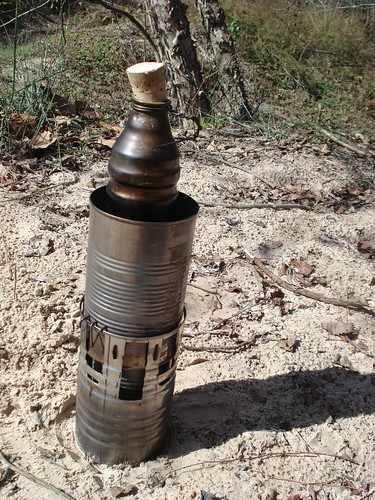
DIY Charcoal Producing Hiking Stove

Here is a good description of a wood gasifier hiking stove made from some cans.

According to the author, the total weight is just 14oz and you don't have to carry any fuel.

The author recommends to completely burn the fuel to ashes. However, if you pour water over the fire after you have boiled whatever you have intended, the charcoal left can be buried in the soil as a soil improving agent as well as carbon sink.

Labels: ,

Saturday, April 19, 2008

Comment to Carbon Negative Energy Source

Reader erich has contributed a very thoughtful comment to a previous post Comment to Carbon Negative Energy Source which I will repost entirely without edit below. Before reading that comment, please also watch is video from qunatumshift.tv


Comment from erich


The best Win Win Win solution is Biochar.

the current news and links on Terra Preta (TP) soils and closed-loop pyrolysis of Biomass, this integrated virtuous cycle could sequester 100s of Billions of tons of carbon to the soils.

This technology represents the most comprehensive, low cost, and productive approach to long term stewardship and sustainability.Terra Preta Soils a process for Carbon Negative Bio fuels, massive Carbon sequestration, 1/3 Lower CH4 & N2O soil emissions, and 3X Fertility Too.

UN Climate Change Conference: Biochar present at the Bali Conference

http://terrapreta.bioenergylists.org/steinerbalinov2107

SCIAM Article May 15 07;

http://www.sciam.com/article.cfm?articleID=5670236C-E7F2-99DF-3E2163B9FB144E40

After many years of reviewing solutions to anthropogenic global warming (AGW) I believe this technology can manage Carbon for the greatest collective benefit at the lowest economic price, on vast scales. It just needs to be seen by ethical globally minded companies.

Could you please consider looking for a champion for this orphaned Terra Preta Carbon Soil Technology.

The main hurtle now is to change the current perspective held that the soil carbon cycle is a wash, to one in which soil can be used as a massive and ubiquitous Carbon sink via Charcoal Below are the first concrete steps in that direction;

S.1884 The Salazar Harvesting Energy Act of 2007

A Summary of Biochar Provisions in S.1884:

Carbon-Negative Biomass Energy and Soil Quality Initiative for the 2007 Farm Bill

Bolstering Biomass and Biochar development: In the 2007 Farm Bill, Senator Salazar was able to include $500 million for biomass research and development and for competitive grants to develop the technologies and processes necessary for the commercial production of biofuels and bio-based products. Biomass is an organic material, usually referring to plant matter or animal waste. Using biomass for energy can reduce waste and air pollution. Biochar is a byproduct of producing energy from biomass. As a soil treatment, it enhances the ability of soil to capture and retain carbon dioxide.
http://www.biochar-international.org/newinformationevents/newlegislation.html

There are 24 billion tons of carbon controlled by man in his agriculture and waste stream, all that farm & cellulose waste which is now dumped to rot or digested or combusted and ultimately returned to the atmosphere as GHG should be returned to the Soil.

If you have any other questions please feel free to call me or visit the TP web site I've been drafted to co-administer. http://terrapreta.bioenergylists.org/?q=node

It has been immensely gratifying to see all the major players join the mail list , Cornell folks, T. Beer of Kings Ford Charcoal (Clorox), Novozyne the M-Roots guys(fungus), chemical engineers, Dr. Danny Day of EPRIDA , Dr. Antal of U. of H., Virginia Tech folks and probably many others who's back round I don't know have joined.

The International Biochar Initiative (IBI) conference held at Terrigal, NSW, Australia in 2007. The papers from this conference are posted at their home page; http://www.biochar-international.org/home.html


.Nature article, Aug 06: Putting the carbon back Black is the new green:
http://bestenergies.com/downloads/naturemag_200604.pdf

Here's the Cornell page for an over view:
http://www.css.cornell.edu/faculty/lehmann/biochar/Biochar_home.htm

University of Beyreuth TP Program, Germany http://terrapreta.bioenergylists.org/?q=taxonomy/term/118

This Earth Science Forum thread on these soils contains further links, and has been viewed by 19,000 self-selected folks. ( I post everything I find on Amazon Dark Soils, ADS here):
http://forums.hypography.com/earth-science/3451-terra-preta.html


Terra Preta creates a terrestrial carbon reef at a microscopic level. These nanoscale structures provide safe haven to the microbes and fungus that facilitate fertile soil creation, while sequestering carbon for many hundred if not thousands of years. The combination of these two forms of sequestration would also increase the growth rate and natural sequestration effort of growing plants.

All the Biochar Companies and equipment manufactures I've found:

Carbon Diversion
http://www.carbondiversion.com

Eprida: Sustainable Solutions for Global Concerns
http://www.eprida.com/home/index.php4

BEST Pyrolysis, Inc. | Slow Pyrolysis - Biomass - Clean Energy - Renewable Energy
http://www.bestenergies.com/companies/bestpyrolysis.html

Dynamotive Energy Systems | The Evolution of Energy
http://www.dynamotive.com/

Ensyn - Environmentally Friendly Energy and Chemicals
http://www.ensyn.com/who/ensyn.htm

Agri-Therm, developing bio oils from agricultural waste
http://www.agri-therm.com/

Advanced BioRefinery Inc.
http://www.advbiorefineryinc.ca/

Technology Review: Turning Slash into Cash
http://www.technologyreview.com/Energy/17298/

3R Environmental Technologies Ltd. (Edward Someus)
WEB: http://www.terrenum.net/

The company has Swedish origin and developing/designing medium and large scale carbonization units. The company is the licensor and technology provider to NviroClean Tech Ltd British American organization WEB: http://www.nvirocleantech.com and VERTUS Ltd.
http://www.vertustechnologies.com

Genesis Industries, licensee of Eprida technology, provides carbon-negative EPRIDA energy machines at the same cost as going direct to Eprida. Our technical support staff also provide information to obtain the best use of biochar produced by the machine. Recent research has shown that EPRIDA charcoal (biochar) increases plant productivity as it sequesters carbon in soil, thus reducing atmospheric carbon dioxide.

http://www.egenindustries.com/


If pre-Columbian Kayopo Indians could produce these soils up to 6 feet deep over 15% of the Amazon basin using "Slash & CHAR" verses "Slash & Burn", it seems that our energy and agricultural industries could also product them at scale.

Harnessing the work of this vast number of microbes and fungi changes the whole equation of energy return over energy input (EROEI) for food and Bio fuels. I see this as the only sustainable agricultural strategy if we no longer have cheap fossil fuels for fertilizer.

We need this super community of wee beasties to work in concert with us by populating them into their proper Soil horizon Carbon Condos.


Erich J. Knight
Shenandoah Gardens
1047 Dave Berry Rd.
McGaheysville, VA. 22840
(540) 289-9750
shengar@aol.com

Labels: