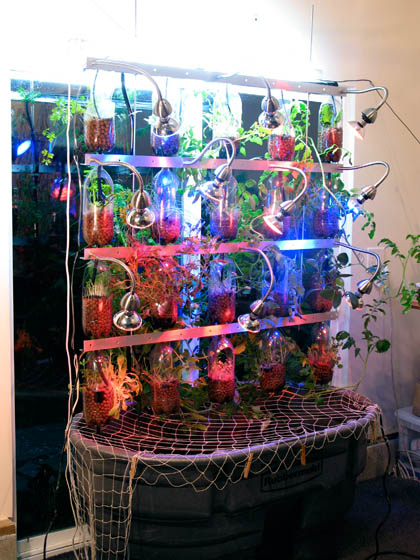
Aquaponics
Aquaponics = Aqua culture + hydroponics. It is a combination of growing fish (aqua culture) and growing plants in a water media.

Simply put, the waste of the fish is used as fertilizer for the plants. Thus. the cleaned water can be reused for fish.
Fish excretes their waste mainly via the gills as ammonia (NH4+). Since plants cannot utilize ammonia directly, we solicit the help of naturally occurring microbes to convert ammonia into nitrite (NO2-) and nitrate (NO3-). What we need is to allow a lot of surface area and good supply of oxygen.

In a typical design of aquaponics, a plant growth bed is built on top of a fish tank. The growth bed is typically a neutral media such as pebbles to provide support for the plant roots. Water from the fish tank is pumped up to the growth bed couple of times per day. The growth bed uses a flood-and-drain design. When the water level in the growth bed reaches a certain level, a siphon action will drain all the water back to the fish tank. As water is drained, air is sucked into the space between the pebbles providing oxygen to the microbes on the pebbles. At the same time, the water falling into the fish tank also helps to oxygenate the water.
There are many different siphon designs. The simplest is to put a bottle over an overflowing pipe. See here for some inspiration.

As the conversion of ammonia (NH4+) into nitrite (NO2-) and nitrate (NO3-) releases H+, the water will become acidic and needs to be neutralized. Since plants do not use a lot of sodium, any non-sodium base can be used such as builder lime (calcium hydroxide) and caustic potash (potassium hydroxide). Both these bases are commonly available and inexpensive.
The input to aquaponics are fish feed (for the fish), sunlight (for plants) and energy to move the water, bases (see above) and regular topping up of water. Unlike aqua culture or hydroponics, there is no need to replace any water. This is truly a zero waste system.
The ratio of fish and plants depends on the amount of fish feed. Fish is cold-blooded and hence food is consumed for movement and growth. At low temperature, fish do not eat and hence there will be little excretion, the amount of nutrients available to plants will be reduced. Here is a calculator to determine the amount of plants and fish for backyard systems.
Aquaponics scale very well, from small system over an aquarium to commercial scale production.


The seawater farming in Eritrea is another commercial example. Seawater is ducted inland and then pumped up several meters. The seawater is first used to farm shrimps, then fish. After these two produces, the now nutrient-rich seawater is used to irrigate fields growing various Salicornia. Salicornia europaea is highly edible, either cooked or raw. The seeds of Salicornia bigelovii contain high levels of unsaturated oil (30 percent, mostly linoleic acid) and protein (35 percent),[7][8] it can be used to produce animal feedstuff and as a biofuel feedstock on coastal land where conventional crops cannot be grown. The seawater is discharged into a swamp of mangroves before reaching the sea finally. Mangroves can be harvested for fire wood and older mangroves for timber. Previously desert land at seashore can now be agricultural land for shrimps, fish, vegetables and timber.
Labels: aquaponics
posted by Albert Ip @ 5:00 pm
0 comments