Sustaining Future

Wednesday, July 16, 2008

Vertical Farm

Since New York Times' article on vertical farm which I have blogged before, there is a bit of interest on the blog sphere on that.

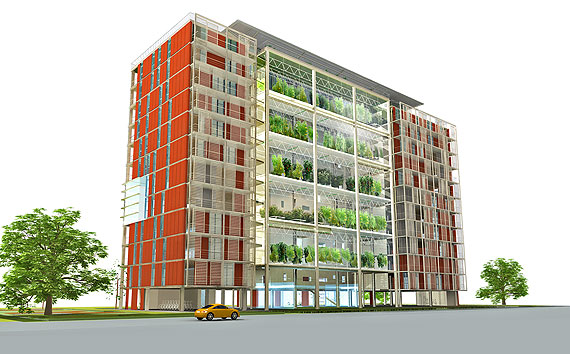
Saving valuable land space for food production in City is a great idea, but there is one important consideration which seems to be missing in all the reporting.

Plant grows by photosynthesis. Photosynthesis needs light. In a high rise structure, which would be quite wide and deep, there will be the issue of getting light into the centre of the building.

At the end of the day, all the energy we have come from the Sun. If we are going to use renewable energy, that will be dependent on the amount of sun light (and wind which is caused by the Sun shining on nearby land mass) available to the building. I am afraid in reality, vertical farm, without additional energy input, would only be a good idea on paper.

Labels: ,

Wednesday, January 02, 2008

High-rise Integrated Food Production and Living

One of the cost of current super-market food distribution model consumes a lot of oil because food are reported to have travel 100's km before they reach the consumer. City living is still the preferred way of life for a large portion of the population. Is there a way to reduce food transportation for city folks?

The previous post Aquaponics is based on single level living (as in a standard lot in Australia) where people have a backyard for fresh vegetable and fish.

Vertical Farming is a high rise, can be in a city, which is for food production.

Another variation is agro-housing in which buildings made for, with, and alongside residential experiments in agriculture. [source]

Both vertical farming and agro-housing can utilize strategies such as aquaponics to solve water supply and waste disposal at the same time.

Labels:

Monday, December 31, 2007

Aquaponics

In the post Every household should breed these flies, I suggested every household should breed these soldier flies. So we have buckets of soldier flies larvae. What should we do about these creatures?

The previous post From waste to food is a hint to my suggested answer: backyard aquaponics - grow your own vegetables and farm your own fish in your own backyard. See a brief history here.

The idea is quite simple. Farm your own fish. The waste from the fish is converted into plant's nutrient by nitrogen-fixing bacteria. The plants grow by absorbing these nutrient and hereby clean the water for the fish to use again.

Do it in your own backyard? Yes, there are lots of small system built by enthusiastic hobbyists which have demonstrated success. See examples. Here is a step by step guide to build one using recycled plastic barrels.

So, I think you would have guessed the answer by now. The soldier fly larvae is the food for the fish!

Labels: , ,

From waste to food

The video linked to this title is a prefect example of good "by-product management". The unused by-product of one system is being integrated into another as input. John Todd's system produces five *valuable* by-products!

Labels: ,